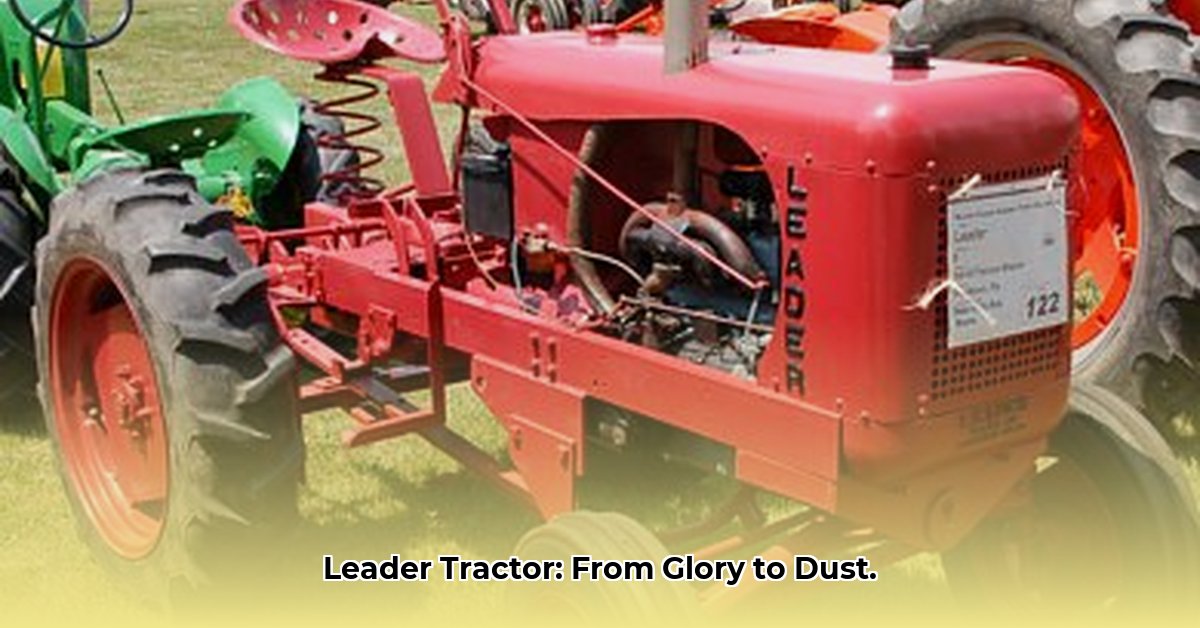
The Leader Tractor Company: a name whispered among vintage tractor enthusiasts, a fleeting chapter in American agricultural history. Its brief existence, from the post-war boom to its ultimate demise, offers a compelling case study in ambition, resource management, and the unforgiving realities of the free market. This isn't just a tale for tractor buffs; it's a story for anyone interested in business history and the challenges of competing against industry giants.
From Garden Tractors to Ambitious Expansion
Leader Tractor's origins were humble, focusing on reliable garden tractors perfect for smaller plots. But the founders saw a larger market: the booming demand for powerful tractors needed for expansive commercial farms. This ambition led to a pivotal decision: a shift from small-scale production to larger, more powerful models. This leap, however, necessitated substantial financial resources and a robust production strategy—a challenge that would ultimately prove insurmountable.
The Leader D: A Workhorse in the Field
The Leader D, a 31-horsepower utility tractor, became the company's flagship model. Featured a three-speed transmission, a 540 RPM power take-off (PTO) vital for powering farm implements, and reliable mechanical contracting band brakes, it represented a solid entry into the competitive landscape. The use of a Hercules engine showcased Leader Tractor's commitment to incorporating reliable and relatively cutting-edge technology into their design. How did it stack up against competitors?
| Feature | Leader D (1947-1949) | Competitor A (e.g., John Deere) | Competitor B (e.g., Ford) |
|---|---|---|---|
| Engine Horsepower | 31 | 25 | 35 |
| Transmission | 3-speed | 2-speed | 4-speed |
| PTO | 540 RPM | 540 RPM | 1000 RPM |
| Drive Type | Two-Wheel Drive | Two-Wheel Drive | Four-Wheel Drive |
| Approximate Weight (lbs) | 2500 | 2200 | 3000 |
(Note: Competitor data represents generalized models of the era. Specific model comparisons require further research.)
A Risky Gamble: Financial Dependence and Downfall
Leader Tractor's downfall wasn't necessarily due to a deficient product, but rather a precarious financial structure. Their heavy reliance on funding from the Schott Brothers—a relationship initially beneficial—ultimately proved fatal. This financing arrangement lacked the stability needed for sustained growth. When the Schott Brothers withdrew support, Leader Tractor faced an immediate and insurmountable cash crunch.
Did Leader Tractor's rapid expansion outpace its ability to secure diverse funding sources? This question highlights a critical lesson in business strategy. Experts suggest a more conservative expansion approach, coupled with broader financial backing, might have improved the company's long-term viability.
Lessons Learned: A Case Study in Risk Management
The Leader Tractor story isn't just about failure; it's a valuable case study. It demonstrates the crucial importance of a strong financial foundation and the dangers of over-reliance on single funding sources. It also illustrates the challenges faced by smaller manufacturers competing against established industry giants. For vintage tractor enthusiasts, Leader tractors represent a fascinating piece of agricultural history. For business students, it's a potent reminder of the complexities of entrepreneurship and risk management.
Key Takeaways:
- The Importance of Diversified Funding: A sole reliance on one financial backer leaves a company vulnerable.
- Controlled Growth Strategies: Rapid expansion without a strong financial base can be unsustainable.
- Competitive Analysis: Understanding the strengths and weaknesses of competitors is crucial for success.
The Leader Tractor Company's legacy serves as a compelling illustration of both entrepreneurial ambition and the harsh realities of the business world, a valuable lesson for both business students and collectors of vintage machinery.